

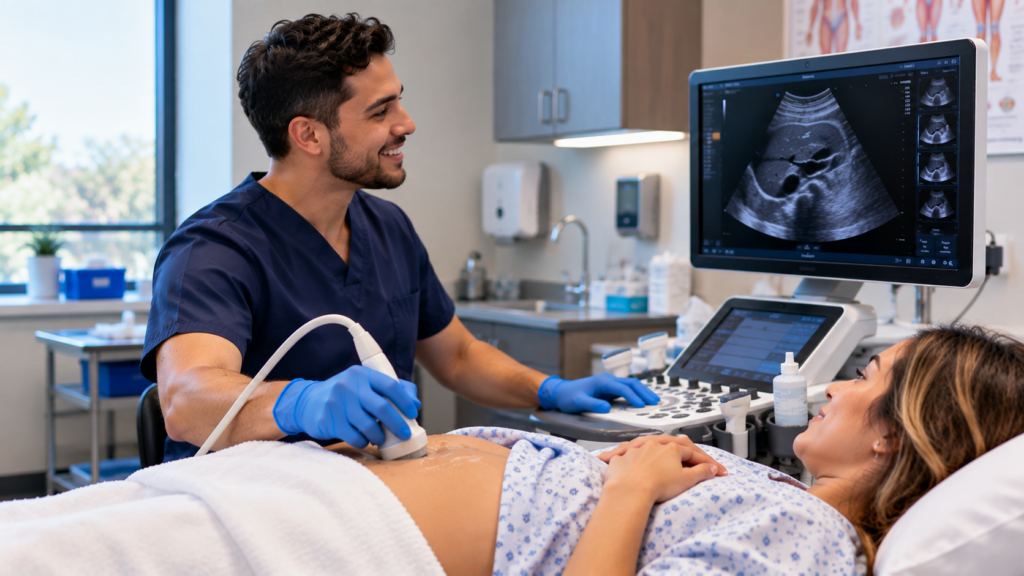
Explore the skills, training, career outlook, and technology associated with a diagnostic medical sonography career.
A diagnostic medical sonography career combines technical imaging skills with direct patient interaction. Sonographers use specialized ultrasound equipment to capture images that physicians can use when evaluating medical conditions.
The role requires attention to detail, critical thinking, communication skills, and an understanding of anatomy and imaging technology. For students interested in healthcare and medical imaging, learning more about the profession can help them determine whether sonography aligns with their educational and career goals.
What Does a Diagnostic Medical Sonographer Do?
Diagnostic medical sonographers perform ultrasound examinations that help physicians assess patients and medical conditions. During an examination, sonographers may position patients, operate ultrasound equipment, obtain measurements, evaluate image quality, and provide technical information for physician review.
Sonographers can work in hospitals, physicians’ offices, medical and diagnostic laboratories, and outpatient care centers. Their responsibilities may vary depending on the healthcare setting and area of specialization.
Skills Used in Diagnostic Medical Sonography
Sonographers rely on a combination of technical and interpersonal skills when performing imaging procedures. Attention to detail is important when positioning patients, adjusting equipment, obtaining measurements, and evaluating image quality.
Critical thinking can help sonographers determine when additional images may be needed for physician review. Communication and patient-care skills are also important because sonographers regularly explain procedures, respond to patient questions, and work with individuals who may be uncomfortable or anxious.
Adaptability is another useful skill as imaging equipment, healthcare practices, and professional expectations continue to evolve.
How RCC Provides Sonography Training
Rockford Career College offers an Associate of Applied Science in Diagnostic Medical Sonography designed to be completed in 19 months. The program requires 112 quarter credit hours and combines classroom instruction, laboratory training, and clinical experience.
Students study subjects including ultrasound physics, anatomy and physiology, abdominal sonography, vascular sonography, gynecological and obstetrical sonography, ethics and medical law, and basic scanning. Laboratory training provides opportunities to become familiar with ultrasound equipment and practice scanning techniques.
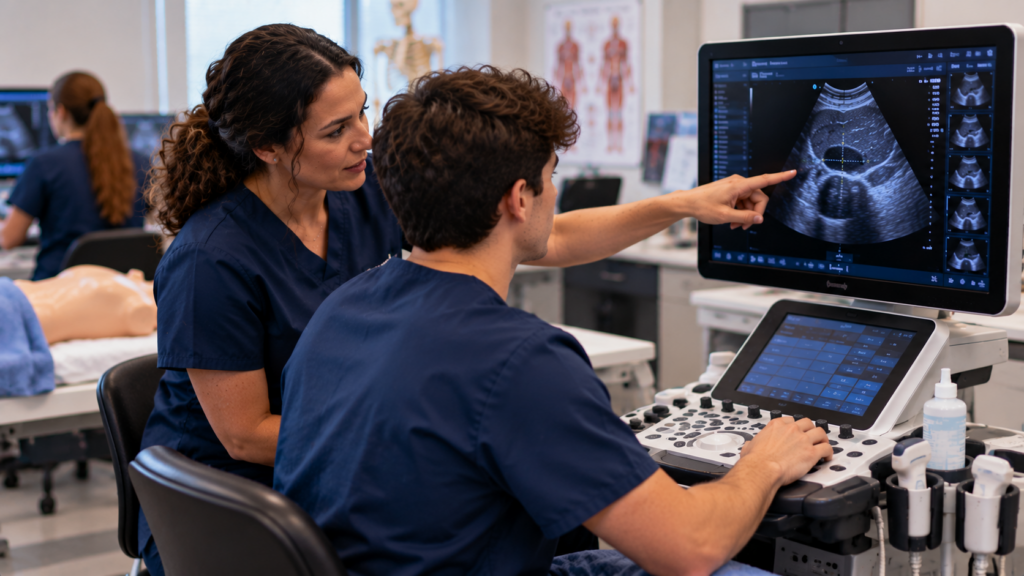
Students also complete clinical externships, providing opportunities to apply classroom and laboratory learning in clinical environments.
RCC’s Diagnostic Medical Sonography program in Abdomen Extended and Obstetrics/Gynecology is accredited by the Commission on Accreditation of Allied Health Education Programs upon the recommendation of the JRC-DMS.
Career Outlook for Diagnostic Medical Sonographers
The U.S. Bureau of Labor Statistics projects employment of diagnostic medical sonographers to grow 14% from 2025 to 2035, with approximately 6,000 openings per year on average during that period.
The BLS reported a national median annual wage of $96,590 in May 2025 for diagnostic medical sonographers. RCC also reports projected employment growth of 15% in Illinois from 2023 to 2033 for this occupation.
Employment projections describe the occupation overall and do not guarantee employment for individual graduates. Employment and salary outcomes vary by location, experience, employer, credentials, and individual circumstances.
Credentials and Continued Professional Development
Professional credentials may be required or preferred depending on the employer, role, and location. RCC’s Diagnostic Medical Sonography program prepares graduates to sit for ARDMS credentialing examinations in specialties such as abdomen and OB/GYN sonography. Certification requirements and employer preferences can vary.
Sonographers may also participate in continuing education throughout their careers. Developments in ultrasound equipment, imaging techniques, point-of-care ultrasound, and artificial intelligence may influence how medical imaging professionals work, making continued learning an important part of professional development.
Explore Diagnostic Medical Sonography at RCC
Students interested in healthcare technology, medical imaging, and patient interaction may want to explore educational opportunities in diagnostic medical sonography.
Rockford Career College offers its Diagnostic Medical Sonography Associate Degree at its Rockford, Illinois campus, combining classroom learning, laboratory practice, and clinical experience.
Explore RCC’s Diagnostic Medical Sonography program to learn more about the curriculum, clinical training, and admissions process and whether the program aligns with your educational goals.
